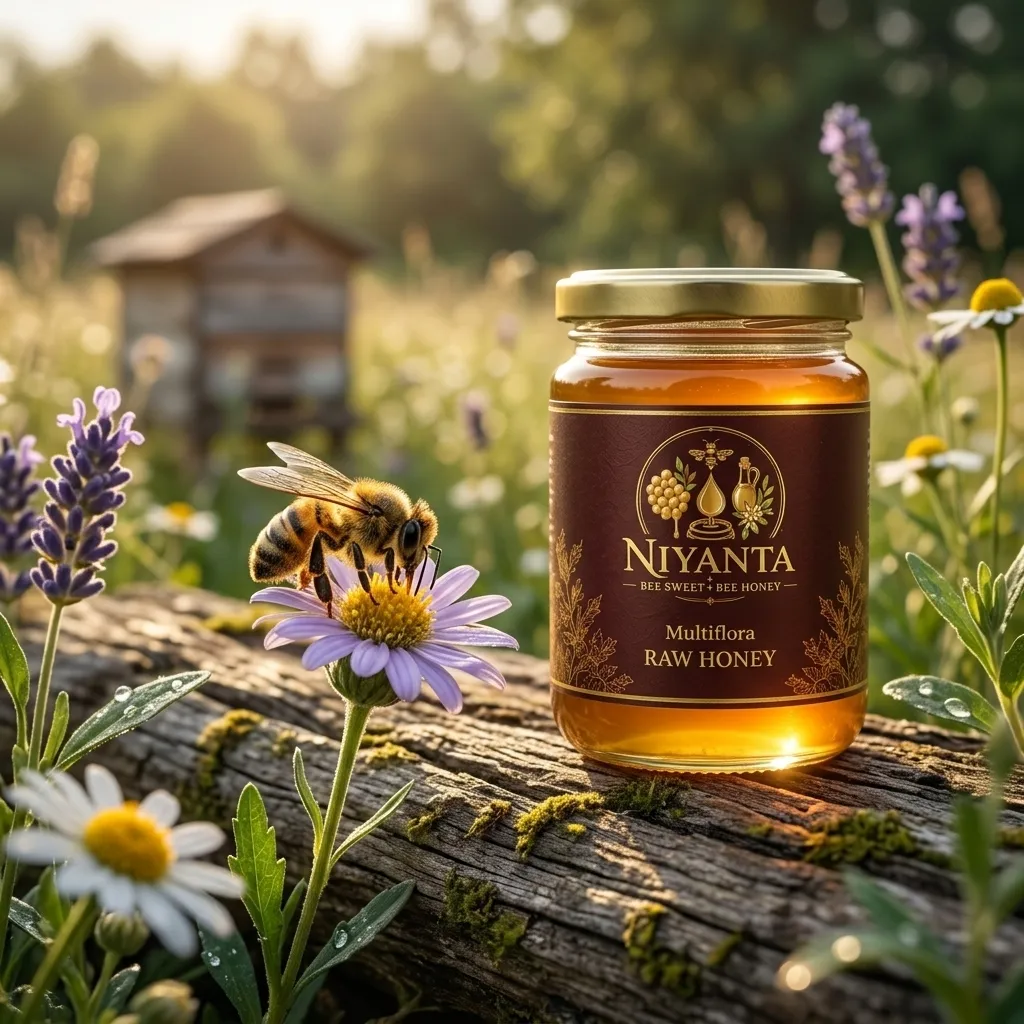
We often talk about the journey of NIYANTA honey from the farm to your table, but the journey that happens before the honey is harvested is a masterpiece of biology. How does thin, watery nectar inside a flower become thick, golden honey?
The Foraging Flight
It starts with a forager bee landing on a blooming flower. Using her long, tube-like tongue (proboscis), she sucks up the liquid nectar. She stores this not in her regular stomach, but in a specialized "honey stomach." Here, the alchemy begins as her body adds the enzyme invertase, which starts breaking down the complex sucrose in the nectar into simpler glucose and fructose.
The Hive Hand-Off
Upon returning to the hive, the forager regurgitates the nectar and passes it mouth-to-mouth to younger house bees. They chew the nectar for about 30 minutes, adding more enzymes and further breaking down the sugars.
The Evaporation
The house bees spit the watery mixture into the hexagonal beeswax cells. Then, thousands of bees fan the honeycomb with their wings, creating a warm breeze that evaporates the water until the moisture drops below 18%. The cell is then capped with wax, preserving the perfect raw honey forever.