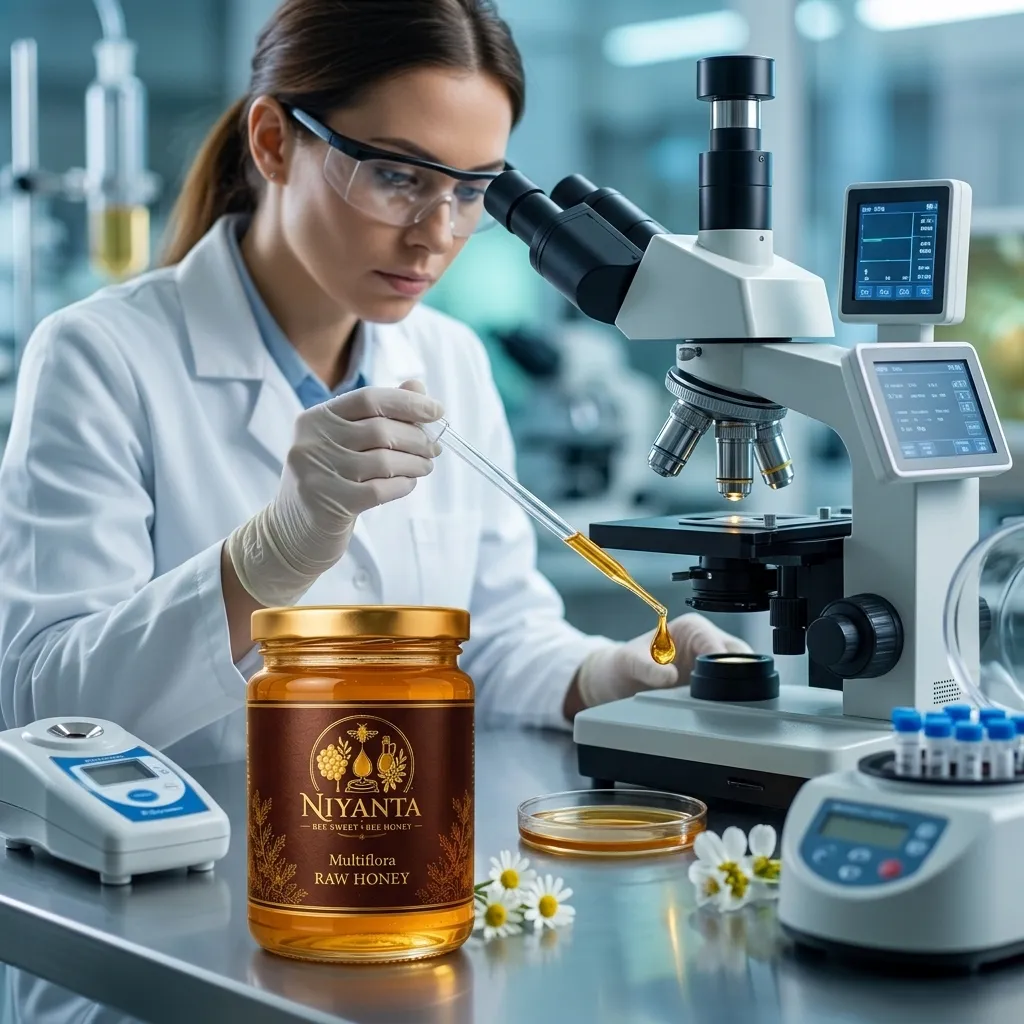
In today’s market, the word "pure" is printed on almost every jar of honey, yet investigations continually reveal widespread adulteration with cheap syrups. At NIYANTA Natural, we don't just ask you to trust us—we prove our purity through rigorous, independent laboratory testing. But what exactly do these tests look for? Let's take a look behind the scenes.
1. The C4 Sugar Adulteration Test
This is the most critical test for honey authenticity. Bees collect nectar from C3 plants (flowers and trees). However, cheap adulterants like high-fructose corn syrup and cane sugar come from C4 plants. By analyzing the isotopic signature of the honey, the lab can detect even the smallest trace of added C4 sugars. If a batch fails this test, it is rejected immediately.
2. NMR (Nuclear Magnetic Resonance) Testing
Adulterators have become highly sophisticated, sometimes using rice syrup which bypasses standard C4 tests. NMR testing is the gold standard globally. It takes a "molecular fingerprint" of the honey and compares it against a database of thousands of pure honey profiles to detect any foreign substances.
3. Moisture Content Analysis
Pure raw honey must have a moisture content below 20% (ideally around 17-18%). If the moisture is too high, the natural yeasts in the honey can cause it to ferment and spoil. By ensuring low moisture, we guarantee that your honey will never expire if stored properly.
4. HMF (Hydroxymethylfurfural) Levels
HMF is a compound that forms when honey is heated to high temperatures. By testing for HMF, the lab confirms that our honey is truly raw and has not been pasteurized or subjected to damaging heat during extraction. This ensures all the natural enzymes remain active for your health.
Our Commitment to Surat
We provide these lab reports because transparency is our core value. You deserve to know what you are feeding your family. To learn more about our entire process, read about the journey of NIYANTA honey from farm to table.